
Recently, Thailand has decided to provide a duty-free, quota-free (DFQF) market facility for Bangladeshi products in its market until 2026 to increase the two-way trade volume. The declaration came as such facilities to Bangladesh by Thailand expired on 31 December 2020. It is high time to analyze the market situation of Thailand to find appropriate strategies to get optimum benefits from the DFQF market facilities offered to Bangladesh.
The journey of Bangladesh–Thailand relations began on 5 October 1972 when Thailand recognized Bangladesh as a sovereign nation-state. The diplomatic ties began with the establishment of the Thai Embassy in Bangladesh in 1974. In order to promote bilateral trade, these two friendly countries signed a bilateral trade agreement on 22 August 1997. They have also formed a joint chamber of commerce to generate maximum output from their economic engagement.
From the very beginning of their relations, these two countries have been enjoying very warm ties and have been working to deepen their bilateral ties for mutual benefit. The bilateral linkage between these two countries has been strengthened over time because of shared strong commitment to democratic values, efforts to foster international peace, harmony, and security. Their cultural, social, and religious linkages also contributed to the blossoming of ties.
In South Asia, Bangladesh is the third-largest trading partner of Thailand. Although the bilateral trade between these two countries crossed $1.25 billion in 2018, it has experienced a declining trend since. As bilateral trade between them dropped to $910.05 million in 2020 from $1,067.90 million in 2019, they should work together to increase bilateral trade and investment.
As Bangladesh has eight export processing zones and has undertaken initiatives to establish 100 Special Economic Zones, it should try to attract Thai investors by informing them of the different incentives and facilities available here such as tax holiday or One-Stop Service in EPZs and EZs
Bangladesh basically exports vegetables, plastic items, rubber products, soap, animal goods, apparel, electrical and electronic equipment, fish, medicines, and other items to Thailand. On the other hand, Bangladesh imports cement, iron and steel, cereals, organic chemicals, machinery and mechanical appliances, synthetic fibre, and cotton fabrics, sugar, and sugar confectionery, etc. from Thailand. Bangladesh has a huge untapped bilateral trade prospect to discover with Thailand. It can export pharmaceuticals and health care goods, chemical products, leather goods, jute goods, frozen fish, knitwear and woven garments, ceramic tableware, tea, and more, to the Thai market. As these products have huge demand in Thailand, Bangladesh can earn huge foreign currency by exporting these goods with easy access, the DFQF, provided by Thailand. Bangladesh should also utilize this DFQF market access offered by Thailand to have competitive advantages
If Bangladesh does its homework properly, then it can get maximum output from the DFQF facility offered by Thailand. Firstly, Bangladesh should analyze the Thai market to understand the Thai economy, its cultural practices, and social norms and then assess the consumption habits and patterns of Thai consumers. Bangladesh Embassy in Thailand, the Bangladesh Ministry of Commerce and Industry, and Bangladesh-Thai Chamber of Commerce and Industry can jointly conduct this analysis.
Secondly, Bangladesh should promote local producers to boost their export to Thailand by providing different facilities, such as creating backward linkage for easing production, arranging raw materials for the products that will be exported to Thailand, offering easy loans, and so on Thirdly, responsible government agencies should take initiative to promote and brand Bangladeshi products in the Thai market to increase market demand for Bangladeshi products.
Fourthly, Bangladesh may arrange or participate in a trade fair organized in Thailand to inform the people there about Bangladeshi goods and services. Fifthly, a team of Bangladeshi businessmen may visit Thailand to have a better understanding of the products being sold there and to have an idea about the goods that might be exported there. Sixthly, the existing relations among the businessmen of both countries should be nurtured and expanded for giving the economic engagement a new shape. Seventhly, the governments of both countries should work shoulder-to-shoulder to simplify the regulations to boost exports and enhance bilateral economic engagement.
As Bangladesh has eight export processing zones and has undertaken initiatives to establish 100 Special Economic Zones, it should try to attract Thai investors by informing them of the different incentives and facilities available here such as tax holiday or One-Stop Service in EPZs and SEZs. Government should allocate lands for the businessmen of Thailand in these SEZs with easy terms and conditions. Both countries may rethink and take the joint initiative to flourish the tourism sectors in their respective countries. They should work to ease visa restrictions which not only will boost trade and investment but also make it easy for Bangladeshis to avail Thai healthcare facilities.
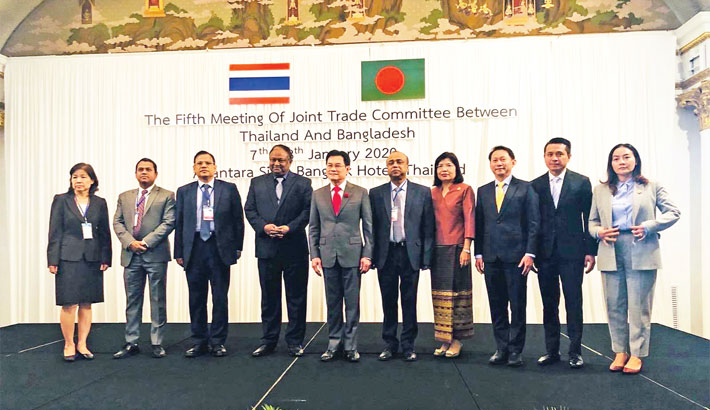
Bangladesh and Thailand have common membership in BIMSTEC which reflects that they have common interests and goals. Besides, in order to address bilateral trade-related issues, they have set up a joint trade commission which is really a praiseworthy initiative. As Bangladesh is officially going to be an LDC-graduate by 2026, it may face different challenges, like cancellation of GSP facilities, which may have a negative impact on its export earnings. In order to avoid a decline in export earnings, Bangladesh should sign Free Trade Agreements with friendly countries such as Thailand.
(Note: This is an unedited and auto-generated story from Syndicated News feed. PriyaSaha.Com Staff may not have modified or edited the content body. Please visit the Source Website that deserves the credit and responsibility for creating this content.)
