
During the 1971 war, US president Richard Nixon and his Assistant for National Security Affairs, Henry Kissinger, spent long hours discussing how they could ‘scare off the Indians’ by encouraging China to threaten India
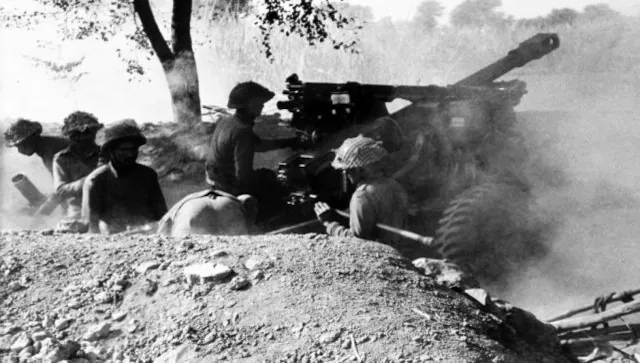
File image of Indian Army soldiers firing on Pakistani positions during the Indo-Pakistani War of 1971. AFP
Fifty years ago, with India’s assistance, Bangladesh freed itself from Pakistani rule. The people of Bangladesh took up arms to fight for their independence when the Pakistani military junta launched a reign of terror on 25 March 1971, in what was then East Pakistan, massacring unarmed civilians and driving ten million Bangladeshis into India. Inevitably, India was drawn into the conflict. War broke out on 3 December and the liberation struggle came to a victorious conclusion on 16 December 1971. On that historic day, the Pakistani armed forces in Bangladesh surrendered unconditionally to the Indian and Bangladeshi forces and Indira Gandhi announced in the Indian Parliament, to deafening applause, that “Dhaka is now the free capital of a free country”.
During the 1971 war, US president Richard Nixon and his Assistant for National Security Affairs, Henry Kissinger, spent long hours discussing how they could “scare off the Indians” by encouraging China to threaten India.
The President’s reactions reflected his dislike of Indians and his antipathy to India’s prime minister, Indira Gandhi. A US diplomat recollects that Nixon customarily referred to Mrs Gandhi as “that b***h” and, when her actions ran counter to the President’s wishes, that sobriquet was “replaced by more unprintable epithets”. Moreover, the Bangladesh liberation war coincided with a dramatic breakthrough in US-China relations. Given the close ties between China and Pakistan, Nixon believed that a pro-Pakistan policy would help forge a new entente with Beijing.
On 6 December 1971 — three days into the war — Nixon threw up the idea of urging China to move troops to its border with India. “We have got to tell them that some movement on their part toward the Indian border could be very significant,” he told Kissinger. “Except the weather is against them,” parried his unenthusiastic adviser.
Kissinger’s reaction is explained by the impressions he had formed during his visits to Beijing in July and October. After the first trip, he reported to Nixon that Zhou Enlai had “recalled the Chinese defeat of India in 1962 and hinted rather broadly that the same thing might happen again”. He reversed this assessment on his second trip, which took place after the conclusion of the Indo-Soviet friendship treaty. The Chinese seemed “afraid of giving Moscow a pretext for attack”, he now informed Nixon.
Two days later, Kissinger offered a more elaborate proposal. He suggested sending a US carrier force into the Bay of Bengal as a signal of support for a Chinese intervention, while urging the Chinese to move to the Indian border. This would “scare off the Indians”. Nixon readily agreed.
Accordingly, on 10 December 1971, a new Task Force including the nuclear aircraft carrier Enterprise was ordered to proceed to the Indian Ocean. The same day, Kissinger met secretly with a senior Chinese representative, Huang Hua, to inform him of the development. He also offered to share US satellite intelligence about Soviet troop dispositions along the Chinese border. In carefully chosen words, Kissinger informed Huang Hua: “The President wants you to know that… if the People’s Republic were to consider the situation on the Indian subcontinent as a threat to its security, and if it took measures to protect its security, the US would oppose efforts of others to interfere with the People’s Republic.”
On 12 December, while Nixon and Kissinger were closeted in the White House discussing their initiative, a message was received from Huang Hua seeking an urgent meeting. This sent Kissinger into a frenzy of excitement. “They are going to move. No question. They are going to move,” he exclaimed. The question of American support for China in the event of a Sino-Soviet confrontation then came up. Nixon revealed his mind. “We may not be able to do it but we’ve got to guarantee it. Shit, they lie to us, we lie to them.”
In his memoirs, The White House Years, Kissinger claims that in this meeting the “first decision to risk war in the triangular Soviet-Chinese-American relationship was taken”. The taped record of the conversation conclusively disproves his assertion. Nixon was responsible for many missteps in the 1971 war but a decision to risk a nuclear war over Bangladesh was not one of these.
When Huang Hua met Kissinger’s deputy later in the day, it turned out that his message concerned a UN resolution, not a military move against India. Kissinger had misread Chinese intentions.
A more basic flaw in Kissinger’s plan was that it flew in the face of American public opinion. There was widespread revulsion in the US media over the brutal Pakistani military crackdown and public opinion would react strongly in the event of armed intervention in support of the Pakistani army. Thus Kissinger hesitated, as the task force stood ready to pass through the Malacca Straits on 13 December. He cabled his deputy, Alexander Haig, “I am weighing (the) advantage of moving it against (the) risk of (it) being called off prematurely by public pressure… In any event, (the) fleet should go into (the) Indian Ocean, not (the) Bay of Bengal.” Thus, the task force sailed toward Colombo, not the Bangladesh coastline, even as the Pakistan army in Bangladesh was preparing to surrender.
Kissinger’s elaborate moves failed to “scare off the Indians”. While taking prudent precautionary measures, Indira Gandhi was well aware of the power of public opinion in the US. Addressing a massive public rally in New Delhi, she sounded a note of defiance for the Indian public, while also directing her remarks to a US audience. Referring to the White House threat of intervention on grounds of treaty obligations to Pakistan, she pointed out that these treaties were intended to “contain Communism… not to fight democracy, or to suppress justice or the voice of the oppressed”.
The Enterprise cruised aimlessly even as the Pakistani army surrendered to the Indian and Bangladesh forces in Dhaka on 16 December 1971.
Chandrashekhar Dasgupta is the author of the recently published, ‘India and the Bangladesh Liberation War’ (Juggernaut publications). The views expressed are personal.
Read all the Latest News, Trending News, Cricket News, Bollywood News,
India News and Entertainment News here. Follow us on Facebook, Twitter and Instagram.
(Note: This is an unedited and auto-generated story from Syndicated News feed. PriyaSaha.Com Staff may not have modified or edited the content body. Please visit the Source Website that deserves the credit and responsibility for creating this content.)
