
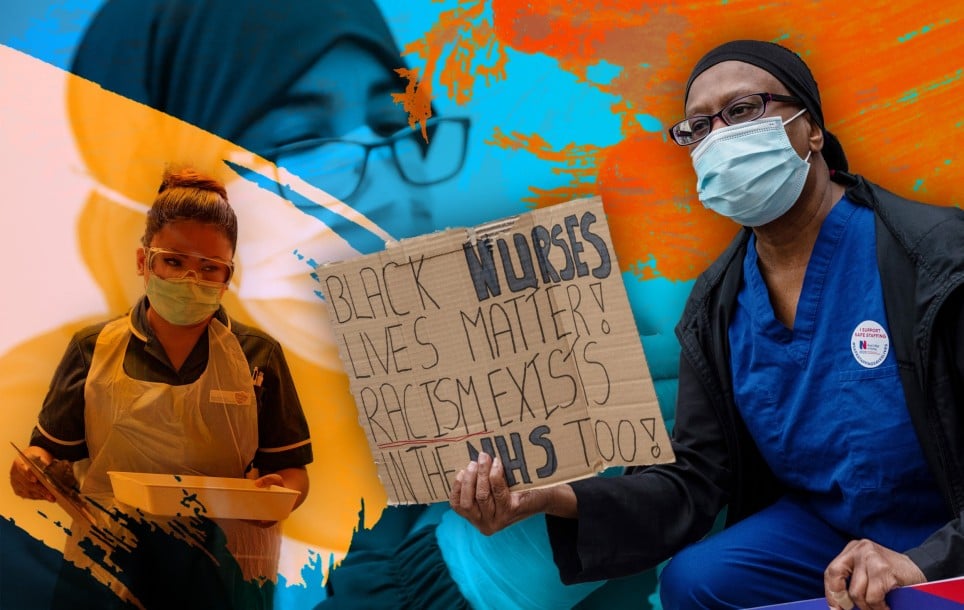
New research which includes powerful testimonies from nurses has revealed ‘shocking and systemic’ levels of racism in the profession.
The study, led by Sheffield Hallam University, involved more than 350 Black and ethnic minority nurses, midwives and healthcare staff across the UK sharing their experiences of racism through the pandemic and during their working lives.
Researchers found that 77% of healthcare staff who challenged racism said they had not been treated fairly. While 59% said they had experienced racism during their working lives that was so bad it made it difficult for them to do their job.
Over half (53%) said they had experienced unfair treatment in the pandemic in relation to Covid deployment, PPE or risk assessment. The same number said they had poorer mental health as result of racism at work.
The Nursing Narratives project research, funded by the Arts and Humanities Research Council, includes around 50 interviews with Black and brown healthcare staff.
Of those interviews, 19 have spoken about their experiences on film to create a resource of extended documentary testimonies which aims to help ‘build a collective voice’.
What the nurses said in those testimonies was incredibly powerful.
Estephanie Dunn is the regional director of the Royal College of Nurses in the North West, and was a participant in the study. She has a lifelong background in nursing, spanning the independent sector and NHS.
‘I joined nursing when I was 18,’ Estephanie tells Metro.co.uk. ‘Joining the profession at such a young age, I thought people would be more understanding, more caring about the people they worked alongside and the people they cared for.’
Instead, over the years, Estephanie has witnessed Black and ethnic minority staff verbally and physically abused by patients, a lack of support from management, and racist attitudes from white members of staff.
In her role as a senior director, Estaphanie says she spends a lot of time supporting ethnic minority staff through horrific experiences of racism, harassment and abuse.
‘I have seen the mental health trauma that they have experienced as a result of the verbal, emotional and physical abuse they experience while working,’ says Estephanie.
‘It is so corrosive, and it reduces their professional confidence, their personal confidence. And they are fearful for their safety.
‘When a member of the public who comes in to visit a relative says to the nurse, “Why don’t you go back to where you come from? I’ll go home and get my gun and come back and shoot you.” How do you carry on working that day? How do you walk across the car park, or wait for your bus to go home?
‘I’m not saying things like this are an everyday occurrence. But when it happens, it is hugely significant.’
Estephanie says the hardest part is knowing that these incidences of racism are witnessed by many people, and yet too few are willing to call it out.
‘There are white people – patients and staff – who have stood up and reported and challenged on behalf of what they have seen or heard a member of staff have to experience. But there aren’t enough of them,’ she says.
‘I think it’s incumbent on all of us to stand up in those situations. When you’re in a position where you can speak up with confidence, you have a duty to do so.’
Racism and the pandemic
In the first month of the UK lockdown, 72% of the NHS and social care staff who died were from Black and ethnic minority backgrounds.
This report concludes that racism and the unequal treatment of ethnic minority staff was a direct cause of the disproportional deaths.
Staff report that ethnic minority nurses were disproportionately sent to work in the most dangerous epicentres for Covid during the pandemic.
The study authors wrote: ‘Discrimination in allocation to high-risk environments must be understood as conscious decision-making and not an oversight. There were examples of pressure, threats and coercion.’
They continue: ‘Some staff did raise concerns collectively with success. However, it is clear that even after questions about risks to Black and Brown staff were raised publicly, they were still often placed in areas of high risk.’
One Fillipino nurse said: ‘We were chosen to be exposed.’
The report also found issues of inequality with PPE. Nurses spoke of PPE being hidden by managers and handed out to individuals through preference, ‘the preferred nurses usually being white,’ read the findings.
Researchers also found evidence that many were denied appropriate PPE, and allocated only surgical masks even when allocated to Covid wards.
Neomi Bennett, a Black agency nurse, described: ‘I was not given protection. I’d asked for… like a proper filtered mask, and I was told I can’t have it because I will scare people.’
The impact of racism on nurses
More than a third of the study participants (33.4%) said they had been forced to take sick leave as a result of racism, while 36% had actually left a job as a result of racism.
The report authors wrote: ‘Black and Brown staff repeatedly spoke about trying to prove that they weren’t lazy.
‘An HCA [healthcare assistant] reflected, “they rarely trust that Black people can do things as well as white people”. Such perceptions have led to over scrutiny and victimisation, severely impacting mental and physical health.
‘It has led to resignations, electing to work as agency nurses, leaving the NHS and, in one instance, leaving healthcare altogether.’
The conclusions of the study
‘This study clearly shows despite the series of initiatives to address inequalities, the culture of the NHS fundamentally remains systemically racist. This put Black and Brown staff at greater risk during the pandemic leading to disproportionate impact and loss of life.
‘Therefore, a radical shift in the institutional approach is needed to change the underlying narratives and dismantle the racialised structures that create an environment and tolerance for racialised inequalities which cause harm.’
Nursing Narratives project research
What needs to change?
As part of the study, researchers called on the participants to help create a ‘manifesto for change’ with actionable points for the NHS, universities and practitioners, and government and regulators.
Here are the points the manifesto calls on the NHS to change:
- Implement a zero-tolerance to racism policy and practice.
- Stop putting Black and Brown staff in danger of death and psychological harm.
- Build a more compassionate NHS with respect and equity for Black and Brown
workers. - Remove whiteness as the benchmark in training and organisational culture
- Build an NHS with equality at the core of health provision for all ethnicities.
- Create clear and real consequences for racist actions, including dismissal,
legal action and referral to regulatory bodies. - Create a fair and transparent recruitment process, including all internal
opportunities. - End the exploitation of Black and Brown workers – delegate work equitably.
An NHS spokesperson said: ‘There is never an excuse for racism or any form of discrimination and it should not be tolerated by anyone, including our hard working and dedicated NHS staff.
‘While our latest equality report shows that we have made progress delivering a zero-tolerance approach to all and any form of discrimination, it is undeniable there is significant room for improvement and we will continue to support NHS organisations to create real and sustainable change in race equality.’
Do you have a story to share?
Get in touch by emailing MetroLifestyleTeam@Metro.co.uk.
MORE : ‘I’ve never been more aware of colourism’: The impact of eczema on Black skin
MORE : Black student had to ‘fight’ onto trains due to racism throughout escape from Ukraine
MORE : If now isn’t the time to talk about racism and anti-Blackness in Ukraine, when is?
(Note: This is an unedited and auto-generated story from Syndicated News feed. PriyaSaha.Com Staff may not have modified or edited the content body. Please visit the Source Website that deserves the credit and responsibility for creating this content.)
