
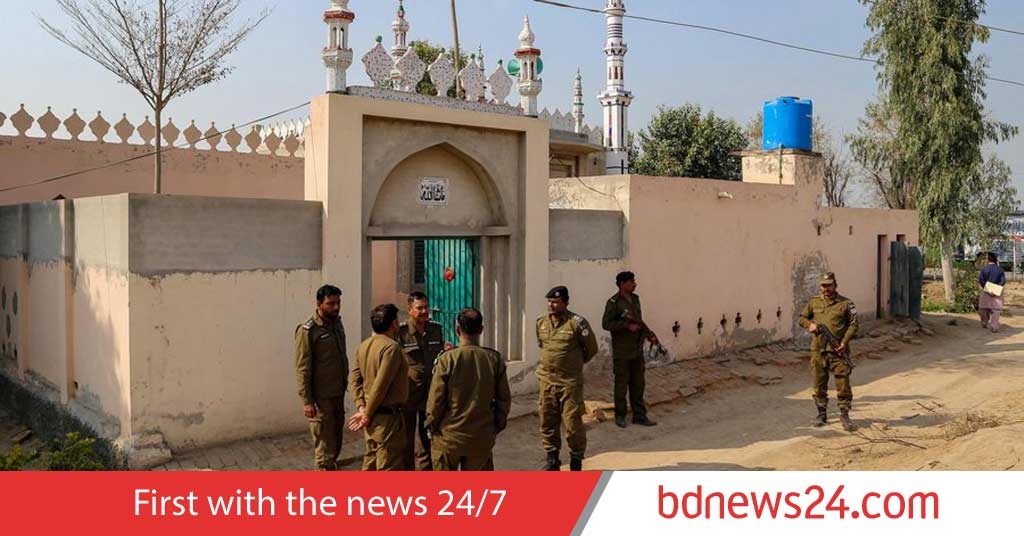
Mushtaq was tortured for hours and
eventually killed, his body hung from a tree. A handful of police officers were
among those who watched.
The Feb 12 killing in the district of
Khanewal was denounced across Pakistan. Prime Minister Imran Khan said the
government had “zero tolerance” for such mob violence and promised that the
police officers would be punished.
But lynching over offences to Islam, real
or imagined, are far from new in Pakistan, where blasphemy is punishable by
death. Rights activists say lynch mobs exploit anti-blasphemy laws to take
matters into their own hands.
In recent years these episodes have risen
to an alarming level, with increasing cases of fatal violence.
Critics and rights activists say that vows
like those made by the prime minister are mere lip service and that Khan’s
government, much like his predecessors, has not taken any practical steps to
curb violence.
Instances of mob violence, and
state-enforced criminal blasphemy cases, are more frequent in Pakistan than
anywhere else, according to a report by the United States Commission on
International Religious Freedom.
“The lack of political will and commitment
has always stood as the biggest obstacle to prevent the abuse, misuse, and
exploitation of blasphemy laws,” said Tahira Abdullah, a rights activist based
in Islamabad.
Khan’s government is no different from its
predecessors in promising to tackle the menace of religious violence, she said.
But “it is too cowardly to confront” influential religious parties in
parliament, Abdullah said, “and the rampaging militant extremist groups outside
parliament.”
Blasphemy allegations have led to the
vandalizing of Hindu temples and neighborhoods, the burning of police stations
by angry mobs, the lynching of a student on a university campus and the killing
of a provincial governor by his own security guard. After Musthaq’s killing, a
senior police official told a parliamentary committee that 90% of those
involved in blasphemy violence are between the ages of 18 and 30.
Just two months ago, a Sri Lankan,
Priyantha Diyawadanage, was lynched by workers he oversaw in a factory in the
eastern city of Sialkot. Diyawadanage was accused of tearing off stickers with
religious inscriptions from the factory walls. He was tortured for hours by an
enraged mob before his body was thrown off the factory’s rooftop, beaten and
set on fire.
In 2021, at least 84 people faced blasphemy
accusations in courts and from angry street mobs, according to the Centre for
Social Justice, a Lahore-based minority rights group. Three people, including
Diyawadanage, were killed by a mob over such allegations, it noted.
In August, a mob in the Rahimyar Khan
district, also in Punjab province, damaged statues and burned down a Hindu temple’s
main door after a court released an 8-year-old Hindu boy on bail. He had been
charged with blasphemy for allegedly urinating in the library of a madrasa.
Defense lawyers are also at risk. In 2014
gunmen murdered a Pakistani lawyer, Rashid Rehman, in Multan city for defending
Junaid Hafeez, an academic charged with making derogatory comments about the
Prophet Muhammad. Hafeez had been in prison, unable to find a lawyer, before
Rehman agreed to take up his case.
In 2011, two politicians were murdered in
similar episodes. Salman Taseer, then a provincial governor, was killed by a
bodyguard after expressing opposition to blasphemy laws. Shahbaz Bhatti, a
federal minister, was murdered for opposing the death sentence imposed on Asia
Bibi, a Christian convicted of verbally insulting the Prophet Muhammad. Though
Bibi was acquitted in 2019, she fled Pakistan and her lawyer has received death
threats.
“The increasing theocratisation of Pakistan
and rising militant extremism makes it very difficult for lawyers to defend
alleged blasphemers,” Abdullah said. “It takes a great deal of personal courage
and professional integrity to withstand huge overt pressure and threats.”
Law enforcement agencies are not trained,
or equipped to handle, frenzied vigilante mobs, and find themselves
overwhelmed, Abdullah noted.
Pakistan inherited 19th-century British
laws outlining punishments for offenses related to blasphemy. But the
government revamped these laws in the 1980s, introducing new clauses adding
severe penalties and even a death sentence for anyone who insults Islam.
Iran, Brunei and Mauritania are the other
three countries that impose the death penalty for insulting religion.
“Since the death penalty, a mandatory
punishment for blasphemy, was made a law, there have been several bouts of
religion-based violence in Pakistan,” said Peter Jacob, executive director of
the Centre for Social Justice.
While no one has ever been executed for the
offense, violence against alleged blasphemers is hardly unusual.
Rights activists link the current spike in
blasphemy-related violence to the Tehreek-e-Labbaik Pakistan, an emerging
radical religious party. And Islamist parties and militant groups in Pakistan
have been emboldened by the Taliban’s coming to power in neighbouring Afghanistan
last year.
“The government’s narrative about
Islamophobia in the rest of the world” fuels the religion-based violence, Jacob
said.
“This narrative builds on anger among the
youth, which becomes ready-made ammunition for sporadic but large-scale
violence against anyone who is suspected of offering any disrespect to
religious persons, scripture, places or articles,” he said.
Tehreek-e-Labbaik, the radical religious
party, first came to prominence as an organised force when it demonstrated for
the release of Mumtaz Qadri, the police bodyguard who fatally shot Taseer in
2011. Qadri was eventually sentenced to death and hanged in 2016. Since then,
it has shaped itself into a political party, contesting elections and
continuing to unsettle governments.
In April last year, Tehreek-e-Labbaik
organized violent, countrywide protests demanding the expulsion of the French
ambassador after President Emmanuel Macron of France eulogized a French teacher
murdered for showing caricatures of the Prophet Muhammad in a classroom.
The Pakistani Taliban have also announced
support for anti-blasphemy campaigns and promoted armed struggle to protect the
honour of Islam.
Posters offering a reward of some $56,000
to kill Faraz Pervaiz, a Pakistani Christian, for posting anti-Islamic content
on social media often appear in anti-blasphemy protests in the country.
Pervaiz, 34, now living in self-exile in
Thailand, said that he started speaking out for the rights of non-Muslim
communities on social media after a Muslim mob attacked a Christian neighbourhood
in Lahore in 2013, torching more than 150 houses and two churches following
reports that a Christian sanitation worker had blasphemed the Prophet Muhammad.
“Even in Thailand, I feel insecure,” he
said after a Pakistani Muslim refugee shared one of his videos and his location
on social media. Pervaiz left the country in 2014 after receiving threats, he
said.
Journalists in Pakistan have refrained from
reporting on blasphemy cases since the rise of the extremist parties and their
growing influence.
“Covering the issue of blasphemy as a
journalist, and especially for the Urdu-language press, can either get you
killed, or you’ll be fired for jeopardizing the survival of the organization
you work for,” said Razeshta Sethna, a journalist and author of a recent report
on the stifling media environment in the country.
© 2022 The New York Times Company
(Note: This is an unedited and auto-generated story from Syndicated News feed. PriyaSaha.Com Staff may not have modified or edited the content body. Please visit the Source Website that deserves the credit and responsibility for creating this content.)
