
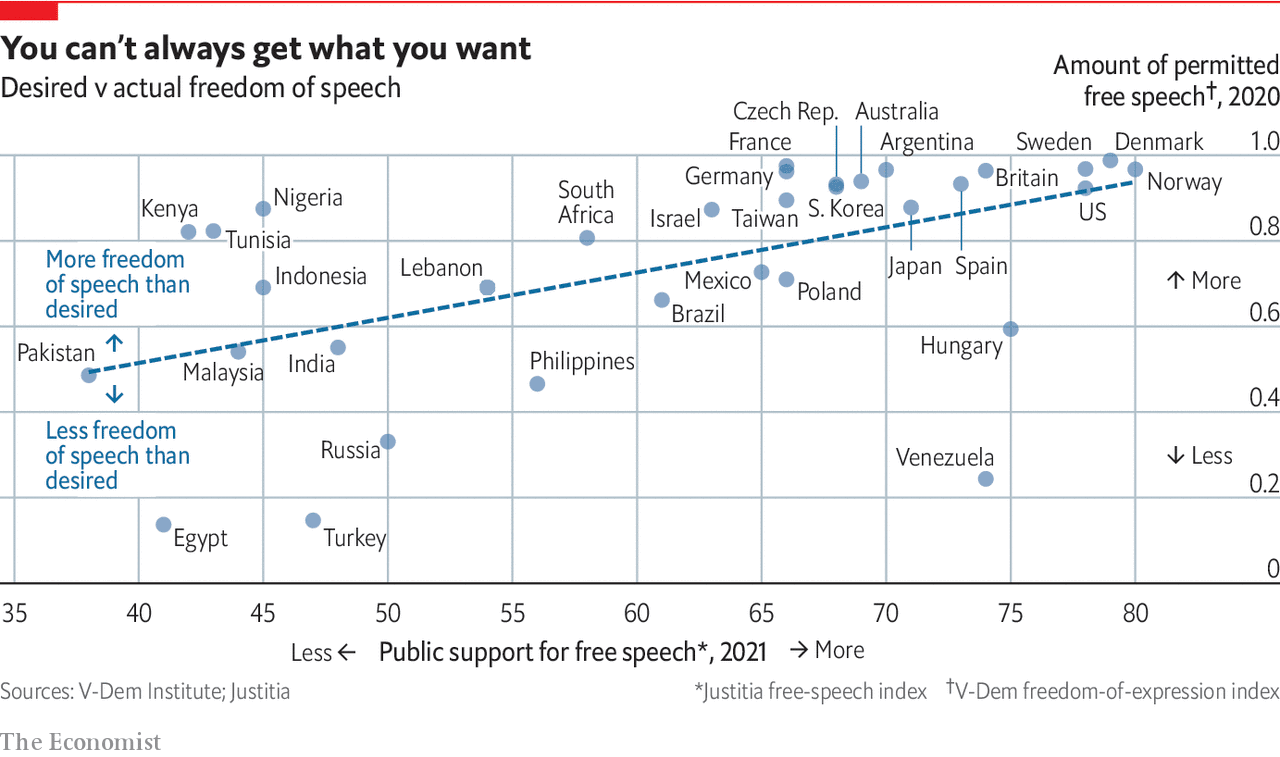
WESTERNERS TEND to regard freedom of speech as a universal good. However, a forthcoming report by Justitia, a Danish think-tank, demonstrates that public support for freedom of expression varies widely among countries, just as legal restraints on speech do. In many countries, particularly authoritarian regimes, people say they want fewer controls. But perhaps surprisingly, in a handful of places poll respondents suggest they want less freedom than they currently have.
The report is based on a survey conducted in February of 50,000 people in 33 countries. The researchers asked respondents whether they believed that a wide range of controversial statements, such as insulting the national flag or making offensive comments about minority groups or religious beliefs, should be permitted. They combined the average responses to each of these questions into an index of support for free speech. They then compared these scores with an index of freedom of expression compiled by V-Dem, another think-tank, which measures how much liberty people in each country enjoy in practice.
In general, the more freedom respondents in a given country said they wanted, the more that country tended to provide. One inescapable weakness in the report’s approach is that people in places with tight restrictions on speech may not feel comfortable telling pollsters how they really feel. However, large shares of respondents in many authoritarian countries, including Egypt, Turkey and Russia, were nonetheless willing to say that they approved of liberties that their governments do not protect. This was particularly true in countries that started to limit freedom of expression only recently, such as Hungary and Venezuela. Perhaps people who once enjoyed freer speech than they do now are more likely to support it than are those who have always lived under stricter rules.
However, just as respondents in many countries said they did not have enough freedom of expression, people in others tended to say they were actually given too much liberty. This pattern was most pronounced in Kenya, Tunisia, and Nigeria. These countries grant rights similar to those found in Japan or Israel, but their citizens tend to disapprove of freedom of speech just as much as people do in Egypt or Turkey—the two countries with the toughest restrictions on expression among the 33 surveyed by Justitia.
Although not enough data is available to explain this phenomenon fully, faith and sectarianism may play a role. In general, respondents in Muslim-majority countries were far less supportive of free speech—particularly when it comes to offensive comments about religion—than those elsewhere. Within the Muslim world, this pattern tends to hold regardless of a country’s form of government: respondents were barely more enthusiastic about freedom of expression in democratic Indonesia than they were in authoritarian Egypt. In both Tunisia and Nigeria, Islamist movements have gained ground over the past decade. They may have shifted public opinion against free speech faster than those countries’ governments could change laws.
Another possible explanation is sectarian conflict. Kenya and Nigeria have been riven by fighting between ethnic groups at various points during the past two decades, and citizens of those countries may fear that hostile speech presages violence. Kenya’s low overall score on support for freedom of expression was driven largely by the 82% of respondents there who said that the government should be able to prevent people from making statements that are offensive to minority groups, which was by far the highest share in the survey. In both rich countries and poor ones, people are often willing to sacrifice civil liberties if they think their safety is at risk.
