
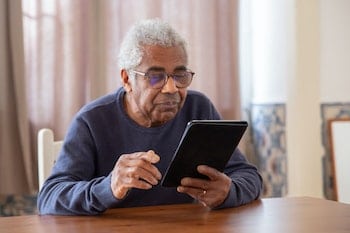
PEOPLE OVER 60 were hit particularly hard by the impact of the pandemic and lockdown.
These are the findings of a research project undertaken by the University of Manchester’s Centre on the Dynamics of Ethnicity and the Runnymede Trust. The research, called Marginalised Voices – the impact of Covid on older ethnic minority people found that ‘the digital divide’ – the gap between those who have access to the Internet and other communication technologies – often played a key role in preventing senior citizens from easily accessing reliable information about public health.
Although senior citizens were more likely to rely on community and voluntary groups to provide support and advice, and lessen the impact of the digital divide restrictions on social contact often meant that these lifelines were removed at exactly the point they were most needed.
It also found that this group were already facing inequalities in housing, health, employment and income.
Marginalised Voices highlighted the fact that “there has been very little investigation into why the impacts have been felt so acutely among this group” adding that “the deficit of research specifically focusing on ethnic minority older people has a detrimental effect on the ability to create effective policy solutions for this demographic”.
The briefing said: “Older ethnic minority people have been deeply affected by isolation as a result of lockdowns associated with the COVID-19 pandemic. The loss of social spaces, like those provided by voluntary, community and social enterprise (VCSE) organisations, have been felt acutely by racially minoritised people in later life, who often use social spaces as a means of accessing cultural connection, support, and advice and information.”
It went on: “The lack of digital access for some ethnic minority older people, coupled with language barriers for others, has further hindered their ability to maintain social connections and access resources and information.”
The majority of older ethnic minority people featured in our study had received, the vaccine but described friends and family members in their community feeling distrust of the government’s motives
Marginalised Voices – the impact of Covid on older ethnic minority people
Another area that the briefing examined is vaccine hesitancy. Recent government research found that Black African and Black Caribbean people are less likely to be vaccinated (50%) compared to White people (70%).
“Vaccine hesitancy is much more complex than has been painted by media discourses” Marginalised Voices said. “The majority of older ethnic minority people featured in our study had accepted, and indeed had received, the vaccine but described friends and family members in their community feeling distrust of the government’s motives, making historical associations with eugenics and testing done on ethnic minority people, and feeling insulted and misunderstood by the racialised messages being conveyed about the reasons for vaccine hesitancy.”
Further explaining this it said: “Distrust of state institutions and health services has been shown to connect to life course experiences of disadvantage and racism, as well as significant historical narratives of medical racism and violence.”
Marginalised Voices makes a number of recommendations. These include a national race equality strategy for the health and social care sector, and plans to address the digital divide for older ethnic minority people which would include training and targeted resources.
(Note: This is an unedited and auto-generated story from Syndicated News feed. PriyaSaha.Com Staff may not have modified or edited the content body. Please visit the Source Website that deserves the credit and responsibility for creating this content.)
