
After independence, it was entrenched in the country’s Constitution, which firmly placed the emphasis on a common history and culture of a people as the nation’s binding force rather than any caste, creed or religion.
One of the cornerstones of the ‘golden Bangladesh’ envisaged by Bangabandhu Sheikh Mujibur Rahman, religious freedom and equality is guaranteed by the Constitution.
But in 2021, a landmark year for Bangladesh as it celebrated 50 years of independence, a wave of hate-fuelled attacks on the country’s Hindu minority threatened the very fabric of a nation that prides itself on religious tolerance and communal harmony.
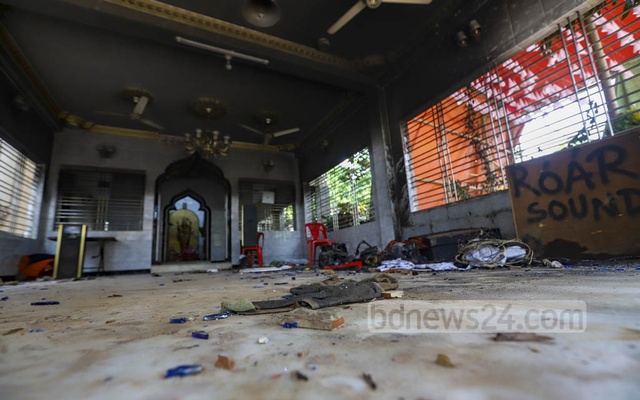
Chandmoni Rakshakali Temple in Cumilla’s Kapriapotti came under attack by religious fanatics following the spread of inciteful posts on social media. Photo: Mahmud Zaman Ovi
As the Hindu community across the country celebrated Durga Puja, their biggest religious festival in October, a provocative social media campaign surrounding the alleged dishonouring of the Quran at a puja venue in Cumilla touched off a horrific chain of events.
Muslim fanatics laid waste to temples and places of worship in the city, leaving scores of people injured. What started in Cumilla soon rippled through to other parts of the country as the Hindu community across Bangladesh faced atrocities which are unprecedented in recent times.
The scars run deep and the trauma lingers on. “The fear that the attacks stoked still exist. We can’t say are over it [even after two months of the attacks],” said Haradhan Chakrabarty, leader of Chandmoni Temple Committee in Cumilla.
“Actually, nobody discusses the issue. Many of us are fuming with fear, grudges and agony. It is burning inside like a chaff fire. In this country, this is the life we have,” he said.

File Photo
The virulent attacks were arguably the biggest talking point of the year. It served as a harrowing reminder of the underlying threat of religious extremism that has reared its ugly head on various occasions throughout Bangladesh’s 50-year journey.
Three decades ago, the destruction of the Babri Mosque in neighbouring India by a Hindu mob sparked a severe backlash against the Hindu community in Bangladesh. And in 2001, Hindus were the biggest casualties of post-election violence that rocked the nation.
Since then, Hindus and Buddhists have been attacked in a few stray incidents. But those pale in comparison to the scale of violence unleashed in 2021, which prompted calls in many quarters for the removal of Islam as the country’s national religion.
According to Manabadhikar Shongskriti Forum (MSF), a human rights group, at least 53 incidents of vandalism and arson attacks targetting puja venues and temples took place in 19 districts in October.
As many as 70 places of worship were attacked and torched in the space of just three days amid the Durga Puja festival, according to the Bangladesh Hindu Buddhist Christian Unity Council.
Nine lives were lost and at least 200 people injured between Oct 13-20. Among the dead, six were Muslims and three were Hindus.

File Photo
Following the violence in Cumilla around Durga Puja, at least 29 Hindu homes in Pirganj were attacked, vandalised and burnt on Oct 17. Once again, Facebook was at the centre of it all as a post on the social media platform that allegedly hurt Muslim sentiments set off the attacks.
As police focused on nabbing the perpetrators, it came in for heavy criticism for failing to prevent the attacks.
On Oct 18, the Police Headquarters issued a statement, saying a total of 450 people had been detained in 71 cases filed over the attacks by religious fanatics.
However, the attackers are yet to be indicted, according to lawyer Rana Dasgupta, general secretary of Bangladesh Hindu Buddhist Christian Unity Council.
“The chief justice ordered the trial of the cases related to communal violence to be completed in 90 days after the complaints were filed,” he said.
“Two months have passed but we haven’t seen any charges formally pressed. Some case dossiers were filed and police arrested some suspects. But we have no idea when the criminals will undergo trials.”
The government promised financial aid to repair the vandalised temples but the funds haven’t yet been disbursed, according to Haradhan Chakrabarty, leader of Chandmoni Temple Committee in Cumilla.

Bangladesh Puja Celebration Council’s Chattogram unit organises a rally at the port city’s Andorkilla demanding punishment to those involved in the recent anti-Hindu attacks in Cumilla and other parts of Bangladesh on Monday, Oct 25, 2021. Photo: Suman Babu
“The only aid we received was Tk 50,000 donated by Dr Pran Gopal Dutta, a trustee of the temple. We topped it up with the temple fund and reinstalled only the lights in the temple during Kali Puja,” he said.
Some of the vandalised temples have been repaired and rebuilt, while many of those injured in the attacks have recovered, said Rana Dasgupta. “But the mental anguish — will they be able to recover from it? They’re living with anxiety, fear and lack of security.”
Human rights activist Noor Khan believes the “failure” of the government and law enforcement to project a strong message against communal violence has left people from religious minority groups susceptible to continual attacks.
“These incidents would have stopped if the government played a strong role. It stopped only after the law-enforcement agencies took stringent preventive measures,” he said.
While looking for the root cause of the attacks, Noor finds a link between the atrocities perpetrated against the Muslim population in India’s Tripura and the violence against Hindus in Bangladesh.
“These incidents can’t be perceived separately,” said Noor. They also raise big questions about the progress made in terms of communal harmony in the 50 years since Bangladesh emerged as an independent nation, according to him.

File Photo
The issue of anti-Hindu violence during Durga Puja was also discussed when Prime Minister Sheikh Hasina sat down with Indian President Ram Nath Kovind during his recent visit to Dhaka.
“While speaking about the problems that occurred during Durga Puja, the prime minister said no one is treated as a minority in Bangladesh and everyone is given equal rights,” State Minister for Foreign Affairs Md Shahriar Alam had said after the meeting.
In the past, many people would come forward to prevent such violence but that was not the case this time around, according to some victims. There weren’t any political activists who stood by them in their hour of need, they claimed.
“The honourable prime minister announced a zero-tolerance policy against communal violence. Only eight to 10 days after her announcement, another attack took place in Habiganj. Now, we need to see what lies ahead for this zero-tolerance policy,” said Rana Dasgupta.
The realisation of secularism, one of the four preambles of Bangladesh’s Constitution, is connected to many other issues, believes Akbar Ali Khan, a former adviser to the caretaker government.
“Bangladesh has successfully achieved nationalism. There’s nothing to worry about. But we need to worry about democracy and secularism in the country. Because, a country which does not have democracy cannot have sustainable secularism,” he said at a recent event.
[Written in English by Sabrina Karim Murshed. Edited by Turaj Ahmad]
(Note: This is an unedited and auto-generated story from Syndicated News feed. PriyaSaha.Com Staff may not have modified or edited the content body. Please visit the Source Website that deserves the credit and responsibility for creating this content.)
