
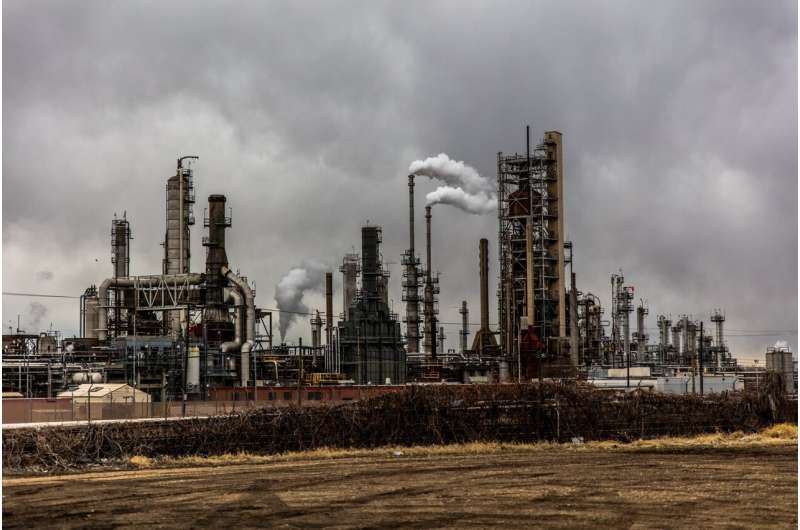
Air pollution is linked to multiple health conditions, including heart disease, cancer and cognitive decline. These effects vary depending on the source of air pollution. And not everyone is equally exposed to poor air quality.
University of Washington researchers investigated disparities in exposure to six major air pollutants in 1990, 2000 and 2010 by comparing models of air pollution levels to census data—including where people live, their racial/ethnic background and their income status.
The team showed that while overall pollutant concentrations have decreased since 1990, people of color are still more likely to be exposed to all six pollutants than white people, regardless of income level, across the continental United States.
The researchers published these results Dec. 15 in Environmental Health Perspectives.
“This is the first time anyone has looked comprehensively at all these main pollutants and watched how they vary over time and space,” said senior author Julian Marshall, UW professor of civil and environmental engineering. “This paper is a chance to recognize that, while every community is unique, there are some factors that play out over and over again consistently across our country. If we go state by state, there’s no place where there are no environmental justice concerns.”
Previously the researchers showed that Americans of color were exposed to higher concentrations of nitrogen dioxide (NO2), an outdoor pollutant from cars and trucks, in two census years: 2000 and 2010.
Now the team has expanded that research to look at five additional pollutants that are harmful to our health: carbon monoxide (CO), ozone (O3), sulfur dioxide (SO2) and particulate matter—both larger particles, such as dust or pollen (PM10), and smaller particles, such as molecules from vehicle exhaust (PM2.5). For all pollutants except for PM2.5, the researchers also expanded the census years studied to include 1990, in which the Clean Air Act was revised to tackle air pollution and emissions.
“There have been so many improvements,” said lead author Jiawen Liu, UW doctoral student in civil and environmental engineering. “But we still see these disparities persist, even after two decades.”
To get air pollution data for each year, the researchers used models that incorporate pollution estimates from multiple sources, including data from satellites and Environmental Protection Agency monitoring stations. These levels were then mapped onto census demographic groups—including four race/ethnicity categories (Black, Asian, Hispanic and white) and income—to determine estimated exposure to each pollutant for each group across states in the contiguous U.S. and Washington, D.C.
For each location, the team calculated both absolute and relative disparities. For absolute disparities, the researchers subtracted pollution exposures for each group from the average exposure for the state. The team determined relative disparities by dividing the absolute disparity by the average exposure across the country.
“Relative disparities allow us to compare across pollutants,” said Liu, who is also a UW master’s student in biostatistics. “Each pollutant will have a general range of exposure, but when you divide by the average it gives you a basis for how big or small that exposure disparity is.”
Disparities varied from location to location, but for all years and pollutants, a racial/ethnic minority group had the highest level of exposure. This trend continued in 2010, despite cleaner air overall.
One limitation to this approach, the researchers said, is that the pollution models reflect national averages, so they might not be as good at catching unusual pollution events in some communities.
“Essentially, our research is showing these disparities exist,” Liu said. “We’re trying to catch people’s attention and show what is happening now. We hope this information will motivate change.”
“We have to document this,” Marshall added. “This might be new to the scientific literature, but it is not new to the communities that are most impacted by air pollution. These communities have been saying this message for a long time. And it’s important to bring humility to our research.”
Other co-authors on this paper are Lara Clark, who completed this research as a UW civil and environmental engineering postdoc; Matthew Bechle, a UW postdoctoral researcher in civil and environmental engineering; Anjum Hajat, a UW associate professor of epidemiology, Lianne Sheppard, UW professor of environmental and occupational health sciences as well as biostatistics; Adam Szpiro, UW associate professor of biostatistics; Sun-Young Kim, associate professor at the National Cancer Center-Graduate School of Cancer Science and Policy; and Allen Robinson, professor at Carnegie Mellon University. This publication was developed as part of the Center for Air, Climate, and Energy Solutions, which was supported under an Assistance Agreement awarded by the U.S. Environmental Protection Agency.
Disparities in Air Pollution Exposure in the United States by Race/Ethnicity and Income, 1990–2010, Environmental Health Perspectives (2021). DOI: 10.1289/EHP8584
Citation:
Despite cleaner air, pollution disparities for people of color remain across the US (2021, December 15)
retrieved 15 December 2021
from https://phys.org/news/2021-12-cleaner-air-pollution-disparities-people.html
This document is subject to copyright. Apart from any fair dealing for the purpose of private study or research, no
part may be reproduced without the written permission. The content is provided for information purposes only.
(Note: This is an unedited and auto-generated story from Syndicated News feed. PriyaSaha.Com Staff may not have modified or edited the content body. Please visit the Source Website that deserves the credit and responsibility for creating this content.)
